When You Need an Articulated Dump Truck (ADT vs On-Road Dump)
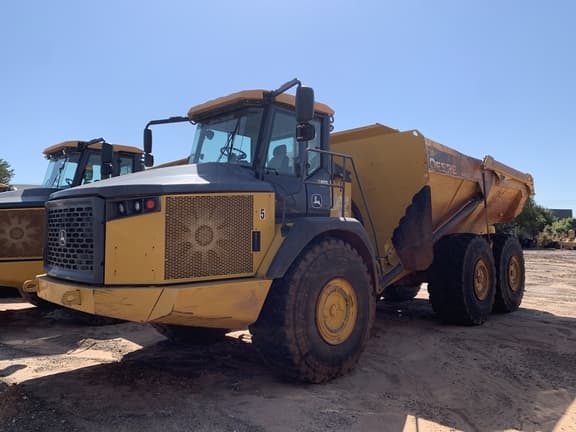
Not every “dump truck” does the same job. An articulated dump truck (ADT) is built for off-highway earthmoving cycles on soft or uneven haul roads. An on-road / highway dump is built to move material under road-legal rules on public pavement. Mixing those classes is one of the more expensive buyer mistakes in used equipment. Track & Blade is a marketplace connecting buyers and sellers — we are not the seller of record, not a yard, and not a hauler. Narrow the fork here, then browse live listings and arrange inspection and transport with the seller.
Off-road cycles vs public-road hauling — two different jobs
Start with where the truck spends its day.
- Off-road / jobsite cycles: Load at the cut or stockpile, haul on temporary dirt or gravel roads, dump at the fill or crusher, repeat. Grades, ruts, mud, and articulation matter more than highway manners.
- Public-road hauling: Load at a pit, plant, or job, then travel on public roads to a dump or customer site under weight, lighting, and licensing rules that apply to highway trucks.
An ADT solves the first pattern. An on-road dump solves the second. If your material mostly never leaves the site or quarry road network, articulating off-highway trucks usually fit. If your payload has to share the highway with other traffic, you are shopping a different class.
Important class note: Trade press often compares ADTs to rigid off-highway haul trucks (large quarry/mine dumpers that also stay off public roads). That is a real fork for big production fleets — but it is not the same as the ADT vs on-road / highway dump decision this guide covers. Rigid off-highway trucks are another off-road family. Highway dumps are road-legal material transporters. Do not shop one when you need the other.
What an ADT is built for (articulation, soft/uneven haul roads)
An articulated dump truck joins a tractor unit to a dump body with a hitch that articulates. That layout helps follow uneven haul roads and keep traction on soft ground where a rigid highway chassis would high-center or simply not belong.
ADT strengths:
- Temporary haul roads that change with weather and cut progress
- Soft, rutted, or steep site grades where flotation and traction matter
- Short-to-medium off-highway cycles between dig face, stockpile, and fill
- Earthmoving fleets already running excavators, dozers, and graders on the same dirt
An ADT is not a substitute for a highway dump when you need to roll through town. It is the truck for the dirt network you build as the job progresses.
What an on-road / highway dump is built for (road-legal material transport)
An on-road dump (also called a highway dump, hi-way dump, or road dump in many buyer conversations) is a truck configured to haul and dump material on public roads. Think tandem or tri-axle dumps, transfer dumps, and similar road-legal dump bodies used to move aggregate, spoil, millings, and construction materials between permitted sites.
On-road dump strengths:
- Legal travel on public highways (subject to weight laws, permits, and how the unit is equipped)
- Plant-to-job and job-to-job material delivery where pavement is the travel surface
- Fleet patterns built around scales, gates, and street routing rather than quarry haul roads
- Crews that already own loaders or excavators for loading and need road miles, not articulating flotation
On Track & Blade, highway-oriented dump and water truck listings live under a thinner hi-way dump / water truck hub. Use that hub for contrast when you are confirming you need road-legal transport — not as a promise of deep ADT-style inventory.
Terrain, grade, and temporary haul roads
Terrain is usually the cleanest filter.
| Condition | Usually points toward |
|---|---|
| Soft fill, mud, rutted cut roads | ADT |
| Steep temporary grades on dirt | ADT |
| Firm quarry benches with dedicated off-highway trucks already in the fleet | ADT (or, on large ops, a separate rigid off-highway conversation) |
| Public pavement, city streets, highway miles | On-road / highway dump |
| Mixed week: some dirt cycles, some road delivery | Often two tools — or be honest about which pattern dominates |
If your “road” is dirt you maintain as the job progresses, shop ADTs. If your road is asphalt with weight rules and traffic, shop highway dumps.
Payload and cycle-time story (conceptual)
Payload and cycle time are site-specific. Do not copy a tonnage or cycle-minute claim from a brochure into your budget without verifying the model, body, and haul profile with the seller and your own job notes.
Reason without inventing numbers: short soft loops favor ADT manners; long paved runs favor highway dumps. Load method (excavator, loader, hopper, plant chute) and dump target (fill edge, stockpile, plant, driveway) constrain spotting and turnaround. An ADT that outruns the diggers or starves the fill is the wrong size for that spread.
Ask sellers about typical application and recent haul conditions — plus articulation/drivetrain notes on ADTs, or chassis, dump hoist, and over-the-road readiness on highway dumps.
Common buyer mistake: buying highway dump for quarry-style off-road
The expensive mistake is buying an on-road dump because it was cheaper or familiar, then asking it to live on soft, steep, temporary haul roads. Highway trucks are optimized for pavement and legal road weight — not for articulating through ruts at the dig face. Buying an ADT for daily public-road runs creates the opposite problem: compliance and utilization headaches.
Watch for: “we’ll take it easy on the dirt” with a highway dump; “we’ll permit it somehow” with an ADT on highway miles; and shopping only “dump truck” keywords without separating off-highway articulated, rigid off-highway, and on-road highway. Name the travel surface first. The class usually follows.
How to read used ADT vs highway dump listings
For ADTs: hours/year/ask together; articulation, tires, and wear photos; body and dump function; then inquire to connect with the seller.
For on-road / highway dumps (contrast): road-oriented configuration clues (verify legality with the seller — do not assume); chassis, hoist, bed, and tires; confirm the listing is a highway dump vs a water truck or other vocational body in the same thin hub.
Asking price is a seller’s starting point, not a Track & Blade appraisal. Inspection and transport are between buyer and seller. Transport follows the seller’s terms — Track & Blade does not haul equipment and does not quote freight as a shipping service.
Browse ADTs (and highway dumps for contrast) on Track & Blade
When the off-road vs public-road fork is clear, open the matching hub.
- Primary: used articulated dump trucks — compare live ADT hours, year, and asking price.
- Contrast only: used hi-way dump and water trucks — a thinner hub for confirming the road-legal side of the fork; do not read it as deep dump inventory.
- Widen across classes on inventory if you are still sorting the job pattern.
- Questions on a specific listing? Contact — or call (405) 873-7772 / email sales@trackandblade.com.
Track & Blade connects buyers and sellers. Choose the class that matches where the truck travels, inquire on the listing, then work inspection, payment, and transport out with the seller — on the seller’s terms, not as marketplace freight.