Excavator for tight spaces
When the gate, the swing, or the neighbors set the size, start with width and weight — then dig depth. Hours and asking price stay on the live card.
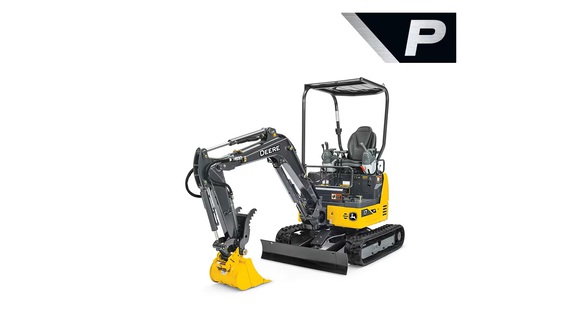
The constraint
A tight jobsite is usually one of three things: a gate or alley that won't take a wide undercarriage, a yard where the house sits close, or a dig where you cannot swing the house over the trench. Pick the machine that fits the opening first. Dig depth is second.
Track & Blade lists machines from sellers. We are not the seller of record. Confirm the unit is still for sale before you commit.
Figures that matter
| Label | What to read |
|---|---|
| Transport width / Undercarriage width | Will it fit the gate retracted or on standard shoes? |
| Operating weight | Heavier usually means more stable — and a harder move on soft ground or a trailer. |
| Dig depth | Maximum digging depth from the OEM sheet (arm stated). |
| Reach | Use the OEM's own label. "Maximum reach at ground level" only when John Deere prints that. "Maximum digging reach" or "Maximum reach" are not the same cell — we do not rename them. |
35 P
Standard arm
870 mm
50 P
Standard arm
1.00 m
60 P
Standard counterweight
1.30 m
75 P
Sheet tail-swing row
1.39 m
Empty OEM cells stay Not published. We do not guess.
Compact vs midi on this job (short band only)
This is not the full ton-class chooser. For that, see How to choose an excavator size.
On a tight site the band split is mostly width:
- Compact / mini — undercarriage often in the 3 ft to 7 ft range. Fits more gates and residential lots.
- Midi — undercarriage often about 7 ft 3 in to 8 ft 1 in on the live JD P-Tier midis below. More dig depth; check the opening before you haul.
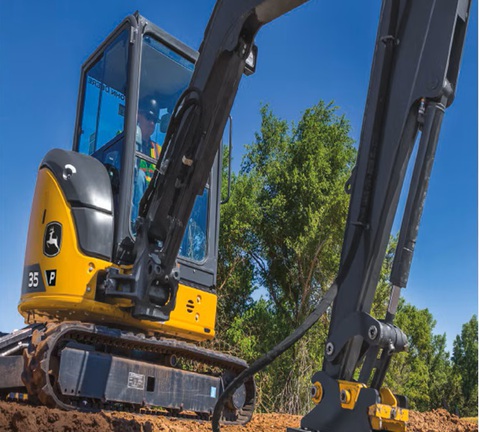
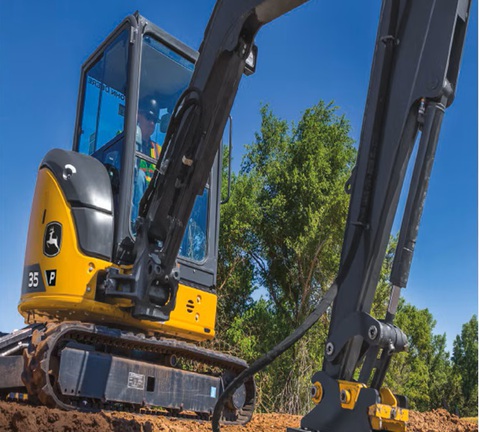

Midi band


Listed now
4 compact excavators for sale (all John Deere P-Tier) and midi examples under excavators. No Bobcat, CAT, Kubota, or Case compact in the live compact hub today.